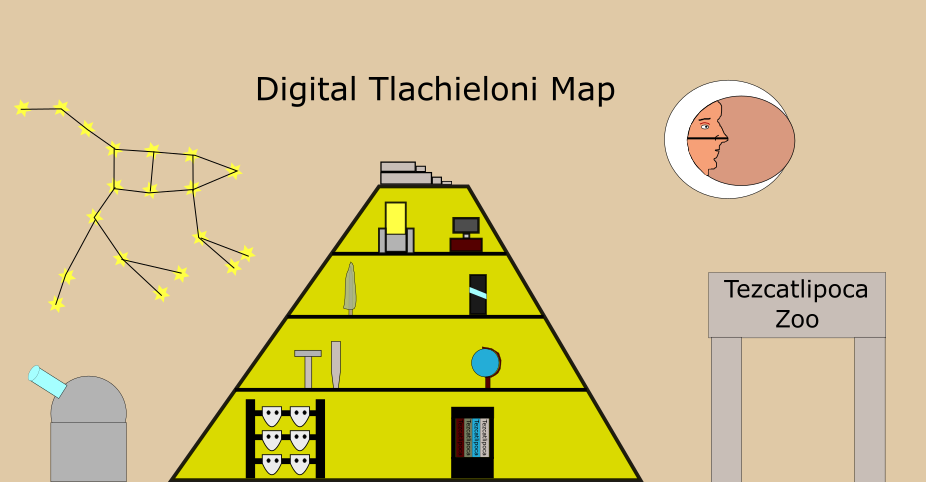
As the name suggests the hall is filled with mirrors, but only on one side. The other side of the hall contains depictions of Tezcatlipoca who are reflected within the mirrors.
Obsidian Cross says: Identity doesn't work for deities the same way it does for humans. You can be yourself and part of a distinct other entity at the same time, or different times. Try not to get lost in the reflections here.
A nuanced and ever changing figure, there are many names and manifestations of Tezcatlipoca. And the line between him and other deities can become incredibly blurred, every other Aztec deity is either sometimes him or has notable iconographic overlap with him. They have yet to invent an Aztec god who isn't at least 40% Tezcatlipoca, and with your support we can expand this to cultures that never interacted with the Aztec.
One commonly seen other name for Tezcatlipoca is Titlacahuan, a general purpose name not linked to any specific aspect or function.
As patron of the days Ome Acatl and Ce Miquiztli, those are also names Tezcatlipoca may be referred to as. The god Iztlacoliuhqui is used interchangably with Tezcatlipoca in the codices, who in turn is conflated with Cineteotl. There is also Ixtilton, an aspect of Tezcatlipoca who foresaw the future in murky dark water and could compel children to speak.
Yaotl is a title applied to many deities, including Tezcatlipoca, but not every instance of Yaotl can be taken to refer to Tezcatlipoca. The world yaotl, meaning enemy or warrior, can be found in other titles more directly linked to Tezcatlipoca: Huitznahuac Yaotl, Huitznahuatl Yaotl, Tlacochcalco Yaotl, and Necoc Yaotl. The last one can be translated as 'enemy of both sides' and refers to his associations with luck and fate, he is the cause of both fortune and misfortune, a warrior's rise and fall.
It is commonly repeated there are four Tezcatlipoca: black, white, blue, and red, with the latter three also being Quetzalcoatl, Huitzilopochtli, and Xipe Totec. However, this is outdated scholarship based on a misunderstanding of the Historia de los mexicanos por sus pintras, which only names two of the four children of the primordial couple as being Tezcatlipoca, Tlatlauqui (red) Tezcatlipoca, and Yayauhqui (black) Tezcatlipoca. Tlatlauqui Tezcatlipoca is indeed associated with Xipe Totec, or Camaxtli while Yayauqui Tezcatlipoca is the one who can simply be called Tezcatlipoca.
While there is no evidence of 'Blue Tezcatlipoca' as a worshipped deity, there are literal blue depictions of Tezcatlipoca, and the relationship between Huitzilopochtli and Tezcatlipoca is one that often blurs the lines of individuality, with it being speculated that Huitzilopochtli may be an aspect of Tezcatlipoca later interpreted as a distinct deity.
As for Quetzalcoatl, there is no sign of him actually being a 'white Tezcatlipoca,' only speculation that he filled the role of one. However, the name Yohuali Ehecatl has been found to refer to both Tezcatlipoca or Quetzalcoatl. They also share an association with the planet Venus.